

| c.10,000 | SEBILIAN Culture ends, began 13,000. Gathered WHEAT V & BARLEY; but had no domesticated seeds. | 10,000 wikPE, wikSbl |
| c.10,000 | LATE PALEOLITHIC Period ends, in Egypt from 30,000. MESOLITHIC (Epipaleolithic) Period 1 begins until 7000. A transition from hunter-gatherers to true farming. Main site: Elkab. |
10,000 Shaw, tregE |
| c.9300 | The Western Desert, abandoned from the Middle Paleolithic, is repopulated because of the Holocene wet phase. | 9300 Shaw 27 |
| c. 9000 | FAYUM-A Period begins until 6000. Earliest fully Neolithic Culture in the Nile Valley. People live around a large lake and subsist on agriculture, hunting, and fishing. People use sickle flints set in wooden handles, large thick flaked tools, winged arrowheads and leaf-shaped pieces. Pottery is crude open pots made with chaff tempered clay, but there is evidence of linen woven from flax and imported beads and shells used as adornments. Burials are in or near settlements. Never developed permanent agricultural villages. Weaving: see Peru 9600, Anatolia 7000 |
9000 wikPE, wohiPPE |
| c.9000 |  QADAN Culture ends, 20 sites in Upper Egypt from 13,000. Economy based on fishing, hunting/gathering. Planted grains but not in ordered rows. First to develop SICKLES and GRINDING STONES. Weapons include spears and darts (or arrows). Practiced ritual burial. Replaced by hunter/gatherers. QADAN Culture ends, 20 sites in Upper Egypt from 13,000. Economy based on fishing, hunting/gathering. Planted grains but not in ordered rows. First to develop SICKLES and GRINDING STONES. Weapons include spears and darts (or arrows). Practiced ritual burial. Replaced by hunter/gatherers. |
map: Mark Dingemanse 10,000 IDBS 678, wohiPPE, 9000 wikPE, wikQd |
| c.8800 | HARIFIAN Culture begins in Sinai and Negev until 8000. Semi-subterranean houses, often more elaborate than Natufian. 1st triangular stone arrowheads. Merges with Pre-Pottery Neolithic B. | 8800 wikPE 88-8500 wikHrf |
| c.8500 | HOLOCENE WET PERIOD begins until 3000. | 8500 wikBK |
| c.8000 | HARIFIAN Culture ends, in Sinai and Negev Desert from 8650. People live in subterranean houses. | 82-8000 wikHrf 8000 wikPE |
| by 8000 | FARMING is entrenched on the banks of the Nile. | by 8000 wikHAg |
| c.7500 | CATS V, domesticated in the fertile crescent from 9000, now domesticated in Egypt. | 7500 wikTop, 7000 Shaw 29 4000 barc |
| c.7000 | MESOLITHIC (Epipaleolithic) Period ends, in Egypt from 10,000. NEOLITHIC Period begins until 4700. EARLY NEOLITHIC Period begins until 6800. |
8800 Shaw 28 7000 Shaw, 5500 tregE |
| c.7000 |  AGRICULTURE spreads from the Fertile Crescent to the Nile. AGRICULTURE spreads from the Fertile Crescent to the Nile. |
timelapse: Wikirictor 5000 TWAH 16 |
| c.7000 |  Sanga CATTLE (Bos taurus africanus) domesticated in NE Africa. Major subgroups: African taurine, Watusi, Zanga. Sanga CATTLE (Bos taurus africanus) domesticated in NE Africa. Major subgroups: African taurine, Watusi, Zanga. |
photo: Bohringer Friedrich 7000 wikHAg |
| c.7000 | Humans in the Nile Valley unevidenced until 5400. | 7000 Shaw 33 |
| c.6800 | EARLY NEOLITHIC period ends, in Egypt from 7000. MIDDLE NEOLITHIC period begins until 5100. | 6800 Shaw 28 |
| c.6100 | A sudden global temperature decrease, probably caused by the final collapse of the Laurentide Ice Sheet, leads to drier conditions in east Africa and Mesopotamia. | 62-6000 wikTop |
| c.6000 | FAYUM-A Period ends, in the Nile Valley from 9000. People live around a large lake and subsist on agriculture, hunting, and fishing. | 6000 wikPE, wohiPPE |
| c.6000 | IRRIGATION V discovered in Egypt, Mesopotamia, and Persia. | 6000 Copilot |
| c.6000 | CIRCUMCISION V evidenced in Egypt, based on evidence from mummies and pictures on walls. | 6000 wikCcA, wikHCc |
| c.6000 | SHEEP, domesticated in Levant from 7700, brought to Egypt, soon spread west to Sahara.. | 6000 PW 13 55-5000 Copilot 5500 bk |
| c.6000 | Λ WHEAT, cultivated in Levant from 9600, Africa from 9000, first cultivated in Egypt. | 6000 PW 13 6000-3150 Copilot 5500 bk |
| c.6000 | BARLEY cultivated in Egypt. | 6000 PW 13, bk |
| c.5900 | Domestic GOATS, in Levant by at least 7450, evidenced in both deserts, but absent in the Nile Valley until c.5400. Africa 5000 | 5900 Shaw 36 5500 bk |
| by 5500 | Small tribes in the Nile valley had developed into a series of cultures having agriculture and animal husbandry, and identifiable by their pottery, combs, bracelets, and beads. The largest in upper Egypt is the BADARIAN V culture, which probably originated in the western desert. | by 5500 wikAE |
| c.5500 | Mesolithic FAYUM-B Period begins in Egypt until 5000. It has small tools (microliths): knives and scrapers, but no pottery. People live from fishing, hunting, and gathering. | 6000 usf, uclF, 5500 aroLEN 5200 anir |
| c.5400 | People still hunt, but start relying heavily on livestock imported from the Levant, mainly goats. | 5400 Shaw 31 |
| c.5400 | Humans, apparently absent from the Nile Valley from 7000, again inhabit it. | 5400 Shaw 33 |
| c.5300 | Chalcolithic PREDYNASTIC Period begins in Lower Egypt until 3000. NEOLITHIC Period begins until 4000. | 6000 wikPE, wohiPPE 5300 RAI3, Shaw 5000 ISBE 1-251, 2-36 4000 ISBE 1-248 |
| c.5200 | Earliest evidence of an agricultural settlement in Egypt. It has remains of domesticated wheat. | 5200 Copilot |
| c.5100 | MIDDLE NEOLITHIC period ends, in Egypt from 6800. LATE NEOLITHIC period begins until 4700. | 5100 wikBK |
| c.5000 | Mesolithic FAYUM-B Period from 5500, ends. | 5000 usf, uclF |
| c.5000 | POTTERY first evidenced in Egypt. See China 9000, Mesopotamia 7000, Levant 6900, | 5000 Copilot 4000 Copilot |
| c.5000 | 2-man wooden PLOW, invented in Mesopotamia 6000, used in Egypt, one man ahead pulling on a rope, the other pressing down the point. | 7000 mxfld |
| c.5000 | Population of the lower Nile is probably less than 20,000. The climate is cold and damp, the people wear long skirts made of linen or skins with the fur inward. They live in tents or perishable wall homes. Hippopotami and crocodiles exist, and at el Badari there are bodies of dogs, sheep and oxen wrapped in matting or linen. | 5000 mxfld |
| c.5000 | BALANCE SCALE V, invented in Egypt. | 5000 Copilot |
| c.5000 | Dikes and canals built along Nile in Egypt. | 5000 TTPC, bk |
| c. 5000 | MERIMDE V Culture begins in west Delta until 4300. Connected to Fayum A culture and the Levant. Shows 5 levels of occupation. Mainly agricultural with cattle, sheep, goats and pigs, and some fishing & hunting. Wheat, sorghum and barley are planted. 1st level has small round or elliptical huts made of wattle and reed. Stone tools. Simple untempered, but sometimes polished, ceramics often decorated with a herringbone pattern.  Dead are buried within the settlement in a flexed position in oval pits without grave goods or offerings. First life-sized Egyptian clay head, shown here, comes from Merimde, and is designed to be mounted on a staff. Hair or feathers may have been inserted in the holes to make a beard. Dead are buried within the settlement in a flexed position in oval pits without grave goods or offerings. First life-sized Egyptian clay head, shown here, comes from Merimde, and is designed to be mounted on a staff. Hair or feathers may have been inserted in the holes to make a beard. |
5000 Shaw 34, wikAAE, wikPE, wohiPPE, 4800 wikAEA, wikMr 48-4750 aroLEN photo: kairoinfo4u |
| c.5000 | WEAVING is 1st evidenced in Egypt in the Fayum. | 5500 Copilot 5000 wikWv |
| c.4700 | Late NEOLITHIC period ends, in Egypt from 5100. | 4700 Shaw, wikBK |
| c.4650 | DONKEY, domesticated in East Africa from 7000, domesticated in Egypt, evidenced at El Omari. Levant 3500 | 48-4500 wikAEA 4000 wikPE, wohiPPE |
| c.4600 | EL-OMARI culture begins in Lower Egypt until 4350. Subsistence on agriculture and animal husbandry: goats, sheep, cattle, pigs, plus much fishing and some hunting. Pottery is simple in shape, often with red coating, often polished. No metal. All graves are pit burials, bodies flexed on left side. | 4600 Shaw 36, aroLEN 4000 wikPE, wohiPPE |
| c.4500 | TASIAN Culture begins in Upper Egypt until 4000. Main site Deir Tasa, contains earliest blacktop-pottery, red and brown pottery that is black on top and interior. The difference between Tasian and Badari is that Badari sites are Chalcolithic while Tasian sites remain Neolithic. | 4500 wikHAE, wikTs |
| by 4500 | Lower Egypt has domestic grazing animals from the Levant. | by 4500 mxfld |
| c.4500 | Λ MERIMDE Culture last phase begins until 4300. Houses are large, well built ovals, densely packed along narrow streets. Houses had their own granaries, sunken water jars, hearths and grinding stones, indicating that each family was an independent economic unit. Ceramics are closed shapes and polished. First dark red or black wares are created, some with impressed or engraved decoration. Only adults are given proper burial; children are thrown in trash pits. No grave goods except a few mussel shells. | no date: aroLEN, wikPE |
| c.4500 | MAADI site in Lower Egypt is occupied until 4000. It shows domesticated donkeys. | 4500 wikAEA |
| c. 4400 | Λ BADARIAN Period, possibly beginning 5000, is evidenced in Upper Egypt until 4000. Earliest agriculture in Upper Egypt. No remains of dwellings have been found, only storage pits and post holes. Pottery made from red Nile clay, often with a black interior and rim and a decorative ripple on the surface created by combing and polishing. They farmed emmer wheat, barley, lentil, and flax and kept sheep, goats, and cattle. They fished, but didn't hunt. Artifacts include high-quality ceramics, bone & stone tools, ornaments, copper, cereals, and wooden objects, plus trade goods from the Red Sea and Levant. Dead, including some domesticated animals, are buried in small cemeteries outside of settlements. Pits are oval or rectangular. The body is in contracted position on left side, facing west with the head to the south. A reed mat or hide is often placed over the body. | 5500 DMoN 4500 mxfld, wohiPPE, 4400 Shaw 36, aeoUEN, wikPE |
Badarian art, 4400-4000 BCE:
 Rama, Nic McPhee |
 String of beads Rogers Fund |
 Hippo vase akhenatenator |
 Burial urn akhenatenator |
| by 4400 | HIERACONOPOLIS "Falcon city" founded by fans of falcon god Horus. | by 4400 wikNkn |
| c.4400 | Finely woven LINEN evidenced in Egypt | 4400 wikPE |
| c.4400 | Oldest-known domestic CATTLE in Africa are in Fayum. | 4400 wikHAE |
| c.4350 | EL-OMARI culture ends, in Lower Egypt from 4600. | 4350 aroLEN 3100 wikPE |
| c.4300 | MERIMDE Culture ends, in west Delta from 5000, in last phase from 4500. | 4300 wikAEA, wikMr 4300-4250 aroLEN 4200 wikAAE, wikPE 4100 Shaw 34 4000 wohiPPE 3100 wikPE |
| c.4000 |  Tasian beaker, found in a Badarian grave at Qau; tomb 569. Tasian beaker, found in a Badarian grave at Qau; tomb 569. |
photo: Hyspaosines 4000 wikPE |
| c.4000 | TASIAN Culture endsn in Upper Egypt from 4500. Main site Deir Tasa. | 4000 copilot |
| c.4000 | MAADI site from 4500 ends. MAADI Culture begins in Lower Egypt until 3500. Maadi, near Cairo, is built over the original Naqada stronghold. Develops architecture and technology, but still has hand made, undecorated ceramics, including black-topped red pots, indicating contact with Naqada sites in the south, and imported vessels from the Levant. Copper adzes have been found. Dead are buried in cemeteries, but with few grave goods. |
4000 wikAEA, wikPE |
| c.4000 | BADARIAN Period ends, in Upper Egypt from 4400. | 4000 Shaw 36, wikPE 3800 DMoN |
| c.4000 | SAIL first used on BOATSΛ in Egypt. | 4000 PW 13 3500 mxfld |
| c.4000 | CEMETERIES become more widely used. | 4000 wikAEM |
| c.4000 | Instances of worn TEETH begin to diminish until 1000 CE, probably due to improved grain grinding. | 4000 wohiPPE |
| c. 4000 | NEOLITHIC Period ends. In Egypt from 5300. NAQADA CULTURE begins in Upper Egypt until 3000. It is divided into Nq1 Amratian, Nq2 Gerzean, Nq3 Protodynastic Period. NAQADA-I (Amratian) Culture begins at El Amra until 3500. Mud-bricks begin to replace reeds as building material. Black-topped and painted pottery continues, but white cross-line pottery, decorated with close parallel white lines crossed by another set of same, begins. People own slaves, build Λ ROWBOATS V of bundled papyrus. Shows increased trade between Upper and Lower Egypt. Trade begins with Nubia, Western desert oases, and East Mediterranean, obsidian from Ethiopia, cedar from Byblos, marble from Paros, emery from Naxos. Dead are buried with food, weaponry, statuettes, decorations, malachite, and occasionally dogs. |
4400 wikNq 4000 GHAE, Shaw 44, wikAAE, wikNC, wikPE, wohiPPE, 3900 wikNC 3800 DMoN |
| c.4000 | JEWELRY: Earliest evidence of Egyptian beads (evidenced from the Mesolithic) usually made of stone, e.g. soapstone, covered with glaze. Other materials used include green feldspar, lapis lazuli, carnelian, turquoise, hematite, and amethyst. | 4500 copilot 4000 copilot, |
Naqada-I art, 4000-3650 BCE
 Figurines of bone and ivory akhenatenator |
 Figurine of bearded man Rama |
 White cross-lined bowl Rogers Fund |
 Black topped vase Keramion |
| c.3800 | At HIERAKONOPOLIS, in Upper Egypt, was slight seasonal rainfall, wooded grasslands, fertile flood plains, and easy access to the Nile. 2 settlements with mud-brick and wattle-and-daub houses are spread over 100 acres and have perhaps 10,000 people. | 3800 mxfld |
| c.3700 | Λ 6 CATS - 2 adults and 4 kittens are next to a baboon and a dog skeletons. Researchers propose that the cats buried together were domestic. | 3700 barc |
| by 3600 | Societies along the Nile had based their culture on crops and domestic animals. Soon after 3600, society grows and advances rapidly toward refined civilization. Pottery like that in south Levant appears. Use of copper becomes common. | by 3600 wikED |
| c.3500 |  RED CROWN (aka deshret) is first evidenced in the late Naqada I period. The crown was likely worn in association with the god Seth. It is not associated with all of Lower Egypt until the first dynasties c.3000. In mythology, the deshret was first given to the god Horus by Geb to symbolize his rule over Lower Egypt. The deshret is then passed on to kings, as successors to Horus. RED CROWN (aka deshret) is first evidenced in the late Naqada I period. The crown was likely worn in association with the god Seth. It is not associated with all of Lower Egypt until the first dynasties c.3000. In mythology, the deshret was first given to the god Horus by Geb to symbolize his rule over Lower Egypt. The deshret is then passed on to kings, as successors to Horus. |
art: GFDL sa-2.5 3500 wikCoE |
| c. 3500 | NAQADA-I (Amratian) Culture in Upper Egypt from 4000 ends. NAQADA-II (Gerzean) culture starts in the delta and moves south until 3200. Represented thruout Egypt. Paintings indicate that hunting persists. With increased food supplies, Egyptians become sedentary, and cities grow as large as 5,000. Stone tools move from bifacial to ripple-flaked construction. Copper is used for tools and weaponry. 1st tombs in classic Egyptian style are built, modeled after ordinary houses, sometimes with multiple rooms. Foreign objects and art enter Egypt, indicating contact with Anatolia and Mesopotamia. 1st Marl pottery, and metalworking. Pottery is more decorated than Amratian, and painted mostly dark red with pictures of animals, people, ships, and geometric symbols derived from animals. Pictures of ceremonial reed Λ BOATS V appear on jars, showing 2 male and 2 female figures standing. "Wavy" jar handles, rare before now, become more common and more elaborate until they are almost completely ornamental. |
3650 wikNC 3500 DMoN, GHAE, Shaw 44, mxfld, wikGrz, wikPE, wohiPPE |
Naqada II art, c.3600-3200
 Figurine, thought to be a deity Naqada II Gerzeh Charles Edwin Wilbour Fund 35-3400 wikNC, wikGrz |
 Comb with human image Early Naqada II Brooklyn Museum 35-3400 wikGrz |
 Jar, Late Naqada II Metropolitan Museum 35-3330 wikGrz, wikNC |
 Pot with elephants on rim from Naqada II Didia 37-3200 wikAEA |
| c.3500 | GERZEAN Culture coincides with decline in rainfall. Farming along the Nile now produces most food. | 3500 wikPE |
| c.3500 | MAADI Culture ends, in Lower Egypt from 4000. | 3500 wikPE 3300 wikHAE 3200 Shaw |
| c.3500 | Large tombs built at Ombos. | 3500 wikNq |
| c.3500 | First ZOO V in the world is built by a pharaohs to keep exotic animals for public display. See China 1975,. | 3500 Copilot, wikNkn |
| c.3500 | MUMMIFICATION 1st evidenced in Egypt. | 3500 wikNq |
| c.3400 |  Gebelein pre-dynastic mummy, with Naqada II decorated jars found beside it. Gebelein pre-dynastic mummy, with Naqada II decorated jars found beside it. |
photo: Jack1956 3400 wikNC 33-3200 wikUkP |
| c.3400 | HIERACONOPOLIS "Falcon city" founded 4400, peaks until ??. Population 5-10,000. | 3400 wikNkn |
 |
art: Francesco Raffaele |
| c.3350 | Gerzeh culture at el Gerzeh Painted Tomb (Tomb 100) at Nekhen (later Hierakonpolis) is cut into the ground, lined with adobe mud brick; its walls elaborately painted. It represents the earliest example of painted walls known in Egypt, and an Egyptian tomb mural. e.g. a mural with barques, staffs, goddesses, and animals painted on its plaster walls. Likely the burial place of a proto-king, of unknown name. | 3500 wikCom 35-3200 thot, wikGrz |
| c.3250 | Egyptian Blue, or cuprorivaite (calcium copper silicate), a synthetic pigment containing copper starts being used in Egypt. | 3250 wikCpr |
| c.3250 |  Gebel el-Arak Knife, Naqada II period from Abydos. At the top of the handle is a Master of Beasts meme, showing influence of Mesopotamia during the Uruk period.Reverse side shows a possible illustration of conflict between Abydos and Hierakonpolis. Gebel el-Arak Knife, Naqada II period from Abydos. At the top of the handle is a Master of Beasts meme, showing influence of Mesopotamia during the Uruk period.Reverse side shows a possible illustration of conflict between Abydos and Hierakonpolis.
|
left: Einsamer Schütze right: ALFGRN 33-3200 wikGrz, wikNC, wikNkn |
| c.3200 |  WHITE CROWN (aka Hedjet) of Upper Egypt is first evidenced in Ta-Seti (North Nubia). What it is made of is debated: leather, fekt, some kind of woven fibers. Images of it have been found in Ta-Seti, a tomb in Deir-el-Bahari, the Narmer Palette, and on a statue of Pharaoh Sesostris. WHITE CROWN (aka Hedjet) of Upper Egypt is first evidenced in Ta-Seti (North Nubia). What it is made of is debated: leather, fekt, some kind of woven fibers. Images of it have been found in Ta-Seti, a tomb in Deir-el-Bahari, the Narmer Palette, and on a statue of Pharaoh Sesostris. |
art: kompak 35-3200 wikCoE 32-3100 wikHjt |
| c.3200 | NAQADA-II (Gerzean) Period in Upper Egypt from
3500 ends. NAQADA-III (Protodynastic) period begins until 3000. More elaborate grave goods, cylindrical jars, 1st hieroglyphs V (disputed), 1st regular use of serekhs (rectangular enclosures mounted by a Horus falcon, indicating that the text enclosed is a royal name), Practiced IRRIGATION, 1st kings & royal cemeteries. After 3200, Lower and Upper Egypt chronology is the same. |
3400 wikSrk 3300 GHAE, wikNC 3200 DMoN, Shaw 44, wikGrz, wikHAE, wikNC wikNq3, wikPE, wohiPPE, 3100 mxfld |
| c.3200 | Dynasty ZERO begins in Egypt until 3100. It includes: Scorpion-I, Iry-Hor, Ka, King Scorpion, and maybe Sekhem, Crocodile, Narmer. |
3250 pic, 3200 wikP, 3150 Murn 3100 wikHAE |
| c.3200 | India trades lapis lazuli to Mesopotamia and Egypt. | 3200 wikIMR |
| c.3200 |  Cosmetic PALETTES such as this "Four dogs Palette" were originally used in predynastic Egypt to grind and apply ingredients for cosmetics. Decorative palettes of the late 4th millennium appear to have lost this function to become commemorative, ornamental, and possibly ceremonial. Almost all are made of siltstone. Cosmetic PALETTES such as this "Four dogs Palette" were originally used in predynastic Egypt to grind and apply ingredients for cosmetics. Decorative palettes of the late 4th millennium appear to have lost this function to become commemorative, ornamental, and possibly ceremonial. Almost all are made of siltstone. |
photo: Rama 33-3100 wikNq3 no date: wikCPal |
| c.3150 |  Naqada III hair comb decorated with rows of wild animals. The teeth, now broken off, were at the bottom. Naqada III hair comb decorated with rows of wild animals. The teeth, now broken off, were at the bottom. |
photo: Metropolitan Museum 32-3100 wikNq3 |
| c.3100 | Dynasty ZERO, in Egypt from 3200, ends. It included: Scorpion-I, Iry-Hor, Ka, King Scorpion, and maybe Sekhem, Crocodile, Narmer. |
3050 Morn, pic 3100 wikP, |
| c.3100 |  Naqada III has many notable decorative cosmetic palettes of this time period: Naqada III has many notable decorative cosmetic palettes of this time period:left: Hunters Palette middle: Bull palette right Battlefield Palette. |
left: GFDL middle: Rama right: Joyofmuseums 3100 wikNq3 |
| c.3100 | Pottery bears paintings of sickle-shaped sailing Λ BOATS V, apparently built with reeds and complete with cabins and centerboards. | 3100 mxfld |
| c. 3100 |  SCORPION MACE HEAD, a 25cm long, pear-shaped bulb made of limestone, attributed to king Scorpion due to the glyph of a scorpion engraved by the head of a king wearing the White Crown of Upper Egypt. He is holding a hoe, and standing by a body of water, probably a canal. He is facing a man holding a basket and men holding standards. Men are busy along the banks of the canal. Behind the king are 2 fan holders, some plants, women clapping their hands and a small group of people, all of them facing away from the king. In the top register there is a row of nome standards. A bird is dangling from each of them, strung up by its neck. Discovered at Hierakonpolis. SCORPION MACE HEAD, a 25cm long, pear-shaped bulb made of limestone, attributed to king Scorpion due to the glyph of a scorpion engraved by the head of a king wearing the White Crown of Upper Egypt. He is holding a hoe, and standing by a body of water, probably a canal. He is facing a man holding a basket and men holding standards. Men are busy along the banks of the canal. Behind the king are 2 fan holders, some plants, women clapping their hands and a small group of people, all of them facing away from the king. In the top register there is a row of nome standards. A bird is dangling from each of them, strung up by its neck. Discovered at Hierakonpolis. |
drawing: Benutzer Weneg photo: Jon Bodsworth 3200 SHT 51 32-3000 wikScM 3100 wikAEA |
| c. 3100 | 1st DYNASTY begins until
2890. Hieroglyphs are fully developed; their shapes change little for 3,000+ years. Human sacrifice is part of funerary rituals with all kings. Tombs are mostly wood and mud brick. Manetho contradicts both archeological evidence and other historical records.
 MINI (Menes), probably Falcon king Narmer, is 1st king until 3050, capital Thinis (Abydos). Mini conquers the Lord of the Delta, boasts of taking 12,000 prisoners, 400,000 oxen. Mini is first to wear the double crown. Lower and Upper Egypt are UNITED until 2160. MINI (Menes), probably Falcon king Narmer, is 1st king until 3050, capital Thinis (Abydos). Mini conquers the Lord of the Delta, boasts of taking 12,000 prisoners, 400,000 oxen. Mini is first to wear the double crown. Lower and Upper Egypt are UNITED until 2160. |
art: Jeff Dahl 3400 BCoC 63, BHOE 14, 597, TTPC, 3200 ISBE 1-251, WERE 3150 GHAE, wikHAE 3100 B76 6-460, GEoP 430, MCAW, Shaw, TAWH 16, resh, wikCEC, wikD1, wikP, 3050 DMoN, pic, rcE, treg, 3000 IDB 2-44, IDBS 253 2925 wik 2920 CVK, wikCEC |
| c.3100 | NARMER believed to be the same person as Mini and to have unified Upper and Lower Egypt. Possibly marries Neithhotep. | 3100 wik1DE |
| c.3100 | 1st significant Λ IRRIGATION project created by Narmer/Menes - a series of canals and dams to divert the floodwaters, creating a new man-made lake called Moeris. | 3100 Copilot |
| c.3100 | NUMBERS: An Egyptian mace records a successful military campaign. It contains hieroglyphics for numbers in the 100,000s and 1,000,000s. | 3100 EIHM 39 |
| c.3100 | DAGGERS in Egypt are usually made of copper or bronze, while royalty has gold weapons. Some are adorned as ceremonial objects with golden hilts. | 3100 Copilot |
| c.3050 | MINI, probably Falcon king Narmer, 1st king of 1st dyn of Upper Egypt at Abydos from 3100, ends. TETI-I succeeds until 3000. | 3050 wikD1 3040 wikCEC 3016 pic 2925 GHAE |
| AHA succeeds, followed by 4-7 totally different names, including Djer, Djet, Merneith, Den, Anedjib, Semerkhet, Qaa. | Clay, DMoN, GHAE, JIAE, Murn, Shaw, ktut, pic rcE, wikCEC, wikD1 |
| c. 3000 |  NARMER PALETTE shows an early depiction of an Egyptian king. On one side, the king is depicted with the bulbed White Crown of Upper Egypt; the other side has the king wearing the level Red Crown of Lower Egypt, which makes it the earliest known example of a king wearing both crowns. It contains some of the earliest hieroglyphic inscriptions ever found.. NARMER PALETTE shows an early depiction of an Egyptian king. On one side, the king is depicted with the bulbed White Crown of Upper Egypt; the other side has the king wearing the level Red Crown of Lower Egypt, which makes it the earliest known example of a king wearing both crowns. It contains some of the earliest hieroglyphic inscriptions ever found.. |
photo: {{PD-US}} 31-3000 wikNP 3000 ISBE 4-1035 |
| c.3000 | HOLOCENE WET PERIOD ends, began 8500. | 3000 wikBK |
| c.3000 | PREDYNASTIC Period ends, in Lower Egypt from 5300. ARCHAIC Period begins until 2700. | 3200 ISBE 1-248, 251, 2-36 3150 wohiPPE 3000 RAI3, Shaw, wikPE |
| c.3000 | NAQADA CULTURE ends, began in Upper Egypt 4000. NAQADA-III culture ends, in Upper Egypt from 3200. More elaborate grave goods, first kings, cylindrical jars, writing. EARLY DYNASTIC Period begins until 2700. |
3150 GHAE, wohiOKE, wohiPPE 3100 wikPE 3050 DMoN, treg 3000 Shaw, wikAE, wikNC, wikNq, wikPE 2925 britAE 2900 wikNC |
| c.3000 | Λ Hieroglyphics first evidenced in Egypt. | 3000 PW 14, bk, britAE |
| c.3000 | TETI-I, king of 1st dyn of Upper Egypt at Abydos from ??, ends. ATI-I succeeds until ??. | 3000 Manetho says reign = 57 years |
| c.3000 | MEDICAL V info first recorded. | 3000 wikAEM |
| c.3000 | ARAMEANS appear in Egypt. | 3100 IDB 1-190 |
| c.3000 | Egyptian reed Λ BOATS sail as far as Crete and Lebanon. | 3000 B76 16-677 |
| c.3000 | ASTRONOMY V: Egyptian priests note correlation between appearance of SIRIUS on the horizon and flooding of the Nile. | 3000 MCAW |
| c.3000 | CALENDAR V: Pyramid of Cheops at Giza near Cairo includes a tablet recording mythical explanation of extra 5 days added to Egyptian calendar of 360 days. Thoth, god of night, gambled with the moon, winning 5 new days to add to the calendar, outside the jurisdiction of Ra, god of creation. | 3000 kpol |
| by 3000 | PERFUME is made in Egypt. Priests use aromatic resins to sweeten their sacrificial offerings. People believed burning incense connected them with the gods. See China 4500, Cyprus 2000, Mesopotamia 2000 | by 3000 pfms, |
| c.3000 | STAINED GLASS V used with silver to make ornaments and jewelry in Egypt. | 3000 grnw, |
| c.3000 | Λ ZOO/CEMETARY for animal mummies is built at Hierakonopols. | 3000 Copilot |
| c.2955 | ATI-I (Kenkenes), king of 1st dyn of Upper Egypt at Abydos from 3000, ends. HUSAPHAITI (Ousaphaidos) succeeds until ??. | 2955 Manetho says reign = 23 years |
| c.2950 | Earliest known ARCH used in a tomb at Beit Khallaf. | 3000-2900 BHoE 101 |
| c.2935 | HUSAPHAITI or DEN (Ousaphaidos), king of 1st dyn of Upper Egypt at Abydos from ??, ends. MARIBI (Miebidos) succeeds until 2920. | 2935 Manetho says reign = 20 years |
| c.2930 | MARIBI, king of 1st dyn of Upper Egypt at Abydos, declares a "smiting of the Troglodites", maintains a granite quarry in south to pave his tomb at Abydos. | no date: BHoE 48 |
| c.2920 | MARIBI (Miebidos), king of 1st dyn of Upper Egypt at Abydos from 2935, ends. SAMSU (Semempses) succeeds until 2900. | 2920 Manetho says reign = 26 years |
| c.2900 | SAMSU (Semempses), king of 1st dyn of Upper Egypt at Abydos from 2935, ends. QABHU (Qaa) succeeds until 2890. | 2960 GHAE 2900 Manetho says reign = 18 years |
| c.2900 | Papyrus, used for boats from ??, now used for writing. | 1st dyn wikPpr 2700 bk |
| c.2900 | Earliest Λ MEDICAL papyrii are written in Egypt. | 2900 wikAEM 2700 ISBE 1-954 |
| c.2890 | 1st DYNASTY ends, at Thinis (Abydos) from 3100, ends with death of QABHU. 2nd DYNASTY begins until 2700. HETEPSEKHEMUI (Buzau) is 1st king until 2870. | 2925 DMoN, GHAE 2890 B76 6-464, Clay, GEoP, MCAW, Shaw, bk, frO, rcE, treg, wikD2, wikHAE, wikP, wikSP, wohiPPE 2860 wikCEC 2775 britAE |
| BOETHOS (Bedjau) is 1st king, followed by 11 kings before Hetepsekhemui. | GEoP |
| GODS of 1st & 2nd dynasties, alphabetically: Anubis, Hathor, Horus (#1), Min, Neith, Osiris, Ptah, Seker, Set, Thoth; also Apis (not pictured) represented by a live bull. Isis does not arrive until the Old Kingdom. Their genealogies, relationships and functions are hopelessly scrambled, often deliberately to serve the whims of prevailing power brokers. All art is by Jeff Dahl, except Seker by Riley Williams. |
BHoE 46, 597 |
 ANUBIS HATHOR HORUS MIN NEITH |
|
 OSIRIS PTAH SEKER SET THOTH |
|
| c.2870 | HETEPSEKHEMUI (Buzau), 1st king of 2nd dyn of Upper Egypt at Abydos from 2890, ends. RANEB (Nebre) succeeds until 2840. | 2870 guess 2837 wikCEC, Manetho says reign = 36 yrs no date: Clay, DMoN, GEoP, JIAE, Shaw, ae, ktut, phou, pic, resh, tig, treg, wikP |
| c.2850 | Egyptian Creation Legend of Sun Worshippers . Sun god Ra, also called Atum, created his son Shu and daughter Tefnut and they worked together to create order in Nu - the chaos of the universe. They created humans from tears of happiness and then made Yah the moon, Geb the earth, and Nut the sky. | 2850 CMoG 2-83-91 |
| c.2840 | RANEB (Nebre), 2nd king of 2nd dyn of Upper Egypt at Abydos from 2870, ends. NINETJER succeeds until 28??. | 2840 guess 2815 pic no date: Clay, DMoN, GEoP, GHAE, JIAE, Shaw, ae, phou, resh, tig, treg, wikP, wikP |
| c.2840 | KAKDU (Kaiekhos), 2nd king of 2nd dyn of Upper Egypt at Abydos from 2870, ends. NINETJER (Binutri) succeeds until 2810. | 2840 Manetho says reign = 39 years |
| c.2825 | Evidence of ORAL SURGERY begins in the 4th Dynasty. | 29-2750 wikAEM |
| c.2810 | NINETJER (Binutri), king of 2nd dyn of Upper Egypt at Abydos from 2840, ends. WENEG or SENED succeeds until 28??. | 2840 guess 2778 pic no date: DMoN, Shaw, ae, phou, wikP |
| c.2810 | BINUTRI (Binothris), 3rd king of 2nd dyn of Upper Egypt at Abydos from 2840, ends. UZNASIT succeeds until 2800. | 2810 Manetho says reign = 47 years |
| c.2800 | UZNASIT (Tlas), 4th king of 2nd dyn of Upper Egypt at Abydos from 2810, ends. SONDI succeeds until 2775. | 2800 Manetho says reign = 17 years |
| c.2800 |  Tomb of 2nd dynasty king SETH PERIBSEN (unknown in reign order) at Abydos contains artifacts including this granodiorite tomb stela and stone vase with the inscription, "tribute of the people of Sethroe". He leaves a funerary cult lasting to at least the 4th dyn. Tomb of 2nd dynasty king SETH PERIBSEN (unknown in reign order) at Abydos contains artifacts including this granodiorite tomb stela and stone vase with the inscription, "tribute of the people of Sethroe". He leaves a funerary cult lasting to at least the 4th dyn. |
stele: GFDL vase: Iry-Hor 2890-2686 wikSP |
| c.2800 | An Egyptian FLEET is maintained in the Red Sea until ? for trade. . | 2800 ISBE 4-60 |
| c.2775 | SONDI (Sethenes), 5th king of 2nd dyn of Upper Egypt at Abydos from 2800, ends. KHAIRES succeeds until 2765. | 2775 Manetho says reign = 41 years |
| 2781 Jul 19 | Egyptian civil ΛCALENDAR: Changed from 6 months of 29 days + 6 months of 30 days, + 1 intercallary month. to 12 months of 30 days + 5 intercallary days at beginning of year, making 265 days total. A real solar year = 365.24219879 days. |
2937-2821 FHBC 24 2850 RAH 58, 67 2781 ISBE 2-35, wikSC |
| 2773 July 17 | Λ ASTRONOMY: Sothic cycle, the rising of SIRIUS on the same day as the new year. Mentioned in an ivory tablet from the reign of Djer. But this date is too late for Djer's reign, so it probably indicates a correlation between the rising of Sirius and the Egyptian lunar calendar, instead of the solar. | 2773 IDBS 254, wikSC |
| c.2765 | KHAIRES, 6th king of 2nd dyn of Upper Egypt at Abydos from 2775, ends. NOFIRKARI succeeds until 2750. | 2765 Manetho says reign = 17 years |
| c.2750 | NOFIRKARI (Neferkhare), 7th king of 2nd dyn of Upper Egypt at Abydos from 2765, ends. SESOKHRIS succeeds until 2720. | 2750 Manetho says reign = 26 years |
| c.2720 | SESOKHRIS, 8th king of 2nd dyn of Upper Egypt at Abydos from 2750, ends. KHASEKHEMUI succeeds until 2700. | 2720 Manetho says reign = 48 years |
| c.2720 | SESOKHRIS (Peribsen?), king of 2nd dyn of Upper Egypt at Abydos from 2750, ends. KHASEKHEMUI succeeds until 2700. | 2720 Manetho says reign = 48 years no date: ktut, phou, resh, tig, treg, wikP |
| c.2710 | KHASEKHEMUI, king of 2nd dyn of Upper Egypt at Abydos, builds temple at Hieraconopolis "Falcon city". A granite doorpost has survived. | no date: BHoE 42 |
| c.2700 | BRONZE used for tools and weapons in Egypt. | 2700 ISBE 1-548 |
| c.2700 | KHASEKHEMUI (Kheneres), king of 2nd dyn of Upper Egypt at Abydos from 2720, ends. His tomb has brick chambers and cut limestone (1st known stone masonry). | 2727 wikCEC 2700 Manetho says reign = 30 years 2686 rcE no date: BHoE 42 |
| c.2700 | ARCHAIC Period ends, in Egypt from 3000. EARLY DYNASTIC Period ends, in Egypt from 3000. 2nd DYNASTY ends, in Upper Egypt at Abydos from 2890. 3rd DYNASTY begins at Memphis until 2613. SANAKHT is 1st king until 2686 at Memphis, which becomes capital of Egypt and remains so until 2160. OLD KINGDOM begins at Memphis until 2181. |
2980 BHoE 597, GHoE, TTPC 4 2800 WERE 2780 RAH 59 2705 pic 2700 GEoP, GHAE, IDB 2-44, ISBE 1-251, 2-37, PW 14, SOTS 24 2688 resh 2686 B76 6-465, CBCOT, Clay, JIAE, MCAW, Shaw 83, TAWH 16, WPOT 81, britAE, rcE, stnr, treg, wikAE, wikD2, wikED, wikHAE, wikOKE, wikP, wikPT, wikSP 2670 wohiOKE, wohiPPE 2650 britAE, treg, ae 2649 wikCEC 2613 wohiOKE, wohiPPE |
Kings are not called pharaohs until the New Kingdom.
| c.2686 | SANAKHT, 1st king of 3rd dyn at Memphis from 2700 ends. NEBKA succeeds until 2667. | 2700 GHAE 2686 CBCOT, GHAE, JIAE, MCAW, Shaw, TAWH 16, WPOT 81, ktut 2668 Clay, rcE, tig, wikP 2650 wikSn 2631 ae 2630 treg, wikCEC |
| c.2667 | NEBKA, 2nd king of 3rd dyn at Memphis from 2686 ends. DJOSER succeeds until 2648. | 2668 Murn, frO, ktut, rcE, resh, stnr, wikP 2667 Shaw 83, phou 2662 DMoN 2630 treg, wikHAE |
| c.2666 | Physician IMHOTEP becomes vizir of Djoser, tries to find medical as well as religious treatments for disease, designs pyramids, begins extensive stone masonry. | 2980 TTPC 2700 bk no date: BHoE |
| Biblical Joseph = Imhotep. | stnr, |
| All pyramids are built on the west bank of the Nile, which, as the site of the setting sun, is associated with the realm of the dead. | wikEPr |
| c.2650 |  6 tier STEP PYRAMID, at Sakkara built by Imhotep, chancellor and high priest of Ra, for Djoser. 1st building completely of cut stone, originally 62.5m tall, with a base of 109m x 121m, and clad in polished white limestone. 6 tier STEP PYRAMID, at Sakkara built by Imhotep, chancellor and high priest of Ra, for Djoser. 1st building completely of cut stone, originally 62.5m tall, with a base of 109m x 121m, and clad in polished white limestone. |
photo: Charles J. Sharp 2940 BCoC 65 2700 ISBE 3-1060 2650 PW 14, wikPDj 2620 BHoE no date: WPOT |
| c.2648 | DJOSER, 3rd king of 3rd dyn at Memphis from 2667 ends. SEKHEMKET succeeds until 2640. | 2667 pic 2649 Clay, Murn, frO, ktut, rcE, resh, stnr, tig, wikP 2648 MCAW, Shaw 83, phou 2623 ae 2611 treg, wikCEC, wikHAE no date: wikP |
| c.2645 |  Buried Pyramid of Sekhemkhet built of limestone at Sakkara, several hundred meters southwest of Djoser's - an unfinished step pyramid. Only one step is finished - base length 115m, blocks are inclined inward 15°. Buried Pyramid of Sekhemkhet built of limestone at Sakkara, several hundred meters southwest of Djoser's - an unfinished step pyramid. Only one step is finished - base length 115m, blocks are inclined inward 15°. |
photo: Pottery Fan 2645 wikBrP |
| c.2640 | SEKHEMKET, 4th king of 3rd dyn at Memphis from 2648 ends. KHABA succeeds until 2637. | 2660 pic 2643 Clay, Murn, frO, ktut, rcE, tig, wikP 2641 resh 2640 Shaw 86, phou 2623 ae 2603 treg, wikCEC |
| c.2637 | KHABA, 5th king of 3rd dyn at Memphis from 2640 ends. SANAKHT or HUNI succeeds until 2613. | 2654 pic 2637 Clay, JIAE, Murn, Shaw 87, frO, ktut, phou, rcE, resh, tig, wikP 2630 wohiOKE 2619 ae 2599 treg, wikCEC |
| c.2637 |  Layer Pyramid, possibly of Khaba built of natural bedrock and mudbricks 7km north of Sakkara. Originally planned to be 5 steps, 42-45m high (today only 17m), base 84m, surrounded by a necropolis housing large mastabas of high officials. A mortuary temple is built east of it. Layer Pyramid, possibly of Khaba built of natural bedrock and mudbricks 7km north of Sakkara. Originally planned to be 5 steps, 42-45m high (today only 17m), base 84m, surrounded by a necropolis housing large mastabas of high officials. A mortuary temple is built east of it. |
plan: Iry-Hor photo: PotteryFan 2630 wikLP |
| c.2625 |  Head of a king, c.2650-2600. Earliest representations of Egyptian Kings are on a small scale. From the 3rd Dynasty, statues show the ruler life-size. This head wearing the crown of Upper Egypt is larger than life-size. Head of a king, c.2650-2600. Earliest representations of Egyptian Kings are on a small scale. From the 3rd Dynasty, statues show the ruler life-size. This head wearing the crown of Upper Egypt is larger than life-size. |
photo: Edwin Wilbour Fund 2650-2600 wikOKE |
| c.2613 | SANAKHT or HUNI, king of 3rd dyn at Memphis from ?? ends. 3rd DYNASTY ends, at Memphis from 2700. 4th DYNASTY begins until 2494. SNEFRU is 1st king until 2589. | 2900 BHoE 597 2680 RAH 59 2650 IDB 2-44 2630 pic 2625 GHAE 2620 GHAE 434 2613 B76 6-465, Clay, JIAE, MCAW, Murn, Shaw 87, WPOT 81, bk, frO, ktut, phou, rcE, resh, stnr, tig, wikD4, wikEPr, wikHAE, wikOKE, wikP, wohiOKE 2597 DMoN 2575 CVK, ae, britAE, treg, wikCEC |
| c.2613 | By the end of the 3rd dynasty WRITING expands to include more than 200 symbols, both phonograms and ideograms. | wikED |
| c.2613 | NUBIA 1st mentioned in an Egyptian text. Snefru raids Nubia. | 2613 B76 VII 430 |
| c.2610 |  MEIDUM PYRAMID is built at Meidum, 72km south of Cairo and abandoned by Snefru. It is thought to be the 2nd pyramid built after Djoser's, and may have been originally built for Huni. It is the first straight-sided one, but it has construction errors, and partially collapsed while still under construction. Height 65m (ruined); would have been 91.65m, base 144m, slope51°. 1st to have an above-ground burial chamber. MEIDUM PYRAMID is built at Meidum, 72km south of Cairo and abandoned by Snefru. It is thought to be the 2nd pyramid built after Djoser's, and may have been originally built for Huni. It is the first straight-sided one, but it has construction errors, and partially collapsed while still under construction. Height 65m (ruined); would have been 91.65m, base 144m, slope51°. 1st to have an above-ground burial chamber. |
photo: Kurohito no date: wikMdm |
| c.2610 | 1st straight sided PYRAMID built at Dahshur by Snefru. | 2600 PW 14 no date: MCAW |
| c.2600 | Snefru sends 40 ships to Byblos to buy cedar to biuld more ships. | recorded in Palermo Stone 2900 LS 24 |
| c.2600 | BALANCE SCALE V, invented 5000, first evidenced in Egypt by carved stones bearing marks denoting mass and the hieroglyphic symbol for gold. | 2600 wikWS, |
| GODS added in Old Kingdom:
Atum, a god closely connected with the sun and the primeval mound, is the focus of a creation myth dating back at least to the Old Kingdom. Atum, who incorporates all the elements of the world, exists within the waters as a potential being. At the time of creation he emerges to produce other gods, resulting in a set of 9 deities, the Ennead, which includes Geb, Nut, and other key elements of the world. The Ennead can by extension stand for all the gods, so its creation represents the differentiation of Atum's unified potential being into the multiplicity of elements present within the world. alphabetically: Anqet, Atum, Geb, Isis, Khnum, Maat, Nephthys, Nut, Ra, Shu, Tefnut. All art is by Jeff Dahl, except Geb by Daniel Toye, Nut by A. Parrot, Tefnut by A8takashi. |
no date: BHoE 46, 597, wikEM |
 ANQET ATUM GEB ISIS KHNUM |
|
 MAAT NEPHTHYS NUT RA SHU TEFNUT |
|
| c.2600 | Snefru develops COPPER mines in Sinai. | 2920 TTPC |
| c.2600 |  BENT PYRAMID built by Snefru at Dahshur, . It rises from the desert at 54°, but the top section (above 47m) is built at the shallower angle of 43°. Maybe the steepness of the original angle showed signs of instability during construction. Maybe Snefru ran low on money, or thought he would die before completing it. Height 104.71m, base
189.43m square. Its original polished limestone outer casing remains largely intact. BENT PYRAMID built by Snefru at Dahshur, . It rises from the desert at 54°, but the top section (above 47m) is built at the shallower angle of 43°. Maybe the steepness of the original angle showed signs of instability during construction. Maybe Snefru ran low on money, or thought he would die before completing it. Height 104.71m, base
189.43m square. Its original polished limestone outer casing remains largely intact. |
photo: lienyuan lee 2600 wikBntP |
| c.2600 | Annual Nile flood lets Egyptian peasants produce enough barley and emmer wheat to feed 3 people, with enough surplus to support flood control projects, public buildings, pyramids. | 2600 TTPC |
| c.2600 | Fish and poultry preserved by sun-drying. | 2600 TTPC |
| c.2589 |  SNEFRU, 1st king of 4th dyn from 2613, dies. His RED PYRAMID at Dahshur is believed to be Egypt's first successful attempt at a "true" smooth-sided pyramid. It was originally cased with white Tura limestone, but only a few of these stones now remain, revealing the red limestone beneath. Height 105m, base 220m, slope 43°. SNEFRU, 1st king of 4th dyn from 2613, dies. His RED PYRAMID at Dahshur is believed to be Egypt's first successful attempt at a "true" smooth-sided pyramid. It was originally cased with white Tura limestone, but only a few of these stones now remain, revealing the red limestone beneath. Height 105m, base 220m, slope 43°.
Son Khnum KHUFU "Khnum protect me" (Greek Cheops) succeeds until 2566. |
photo: Olaf Tausch 2900 BHoE 2606 pic 2589 MCAW, Murn, Shaw 87, frO, ktut, phou, rcE, resh, tig, wikD4, wikEPr, wikOKE, wikP 2586 Clay 2551 ae, treg, wikCEC 2547 DMoN |
| c.2575 | KHUFU, king of 4th dyn, sends expeditions to Nubia for slaves, and Sinai for copper & malachite. He also trades with Byblos for copper and cedar. | no date: BHoE, MCAW, wikKfu |
| c.2575 | GREAT PYRAMID built at Giza by Khufu. Most blocks are of local limestone; some are imported by boat from Tura and Aswan. Covers 13 acres, base 230.6m square, 146.7m tall, slope 51°, 2,300,000 blocks average 28 tons. Herodotus says it took 100,000 workers 20 years. Most stones are not uniform in size or shape. Outside layers are bound together by mortar. | 2590 TAWH 16 2580 bk 2575 MCAW 2570 wikGPG 2530 PW 14 no date: BHoE 117 |
 1. original entrance on northface 2. robbers tunnel (tourist entrance) 3. descending corridor 4. descending tunnel 5. subterranean chamber 6. ascending corridor 7. queen's chamber and air ducts 8. horizontal corridor 9. Gallery 10. King's chamber and air ducts 11. vertical tunnel plan: Flanker |
| c.2575 | Religious texts and canonical lists classifying the categories of creation begin. | 2575 britAE |
| c.2570 | Temple of HATHOR, already existing at Dendera, rebuilt by Khufu. It will be rebuilt many times. | no date: BHoE 119 |
| c.2566 |  Khnum KHUFU "Khnum protect me" (Greek Cheops), 2nd king of 4th dyn from 2589, dies. His pyramid is the worlds tallest man-made structure until 1311 CE when surpassed by Lincoln Cathedral. Khnum KHUFU "Khnum protect me" (Greek Cheops), 2nd king of 4th dyn from 2589, dies. His pyramid is the worlds tallest man-made structure until 1311 CE when surpassed by Lincoln Cathedral.Son REDJEDEF (Djedefre) succeeds until 2558. |
photo: Nina 2583 pic 2566 Clay, MCAW, Murn, Shaw 88, frO, ktut, phou, rcE, resh, tig, wikD4, wikEPr, wikKfu wikOKE, wikP, wohiOKE 2528 ae, treg, wikCEC 2524 DMoN |
| c.2560 | REDJEDEF (Djedefre) is the first king to claim the title "Son of Ra". | no date: wohiOKE |
| c.2558 | 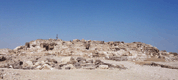 REDJEDEF (Djedefre), 3rd king of 4th dyn from 2566, ends. The history of his pyramid at Abu Rawash is unknown. Its destruction will start by the end of the New Kingdom, and will continue. Ruins are all that is left. REDJEDEF (Djedefre), 3rd king of 4th dyn from 2566, ends. The history of his pyramid at Abu Rawash is unknown. Its destruction will start by the end of the New Kingdom, and will continue. Ruins are all that is left.KHAFRE succeeds until 2532. |
photo: pub dom 2575 pic 2558 Clay, Murn, Shaw 90, frO, ktut, phou, rcE, resh, tig, wikD4, wikEPr, wikOKE, wikP, wikPK, wohiOKE 2520 treg, wikCEC 2518 ae 2516 DMoN |
| c.2550 | Diary of Merer is written with (hieratic) hieroglyphs and published in Egypt on Papyrus. Written by a construction inspector. Mostly consists of lists of daily activities of Merer and his crew. Describes the last years of building the Great Pyramid. They are the oldest known papyri with text. | 2560-50 wikPpr no date: wikDM |
| c.2550 |  SPHINX, the oldest known monumental sculpture in Egypt, built by Khafre on the Giza Plateau on the west bank of the Nile. It measures 73m from paw to tail, 20m high from the base to the top of the head, and 19m wide at its rear haunches. SPHINX, the oldest known monumental sculpture in Egypt, built by Khafre on the Giza Plateau on the west bank of the Nile. It measures 73m from paw to tail, 20m high from the base to the top of the head, and 19m wide at its rear haunches. |
photo: MusikAnimal 2550 MCAW 2500 wikGSG no date: NLEM 22 |
| c. 2532 |  KHAFRE, 4th king of 4th dyn from 2558, ends. His pyramid of limestone blocks weighing more than 2 tons each is 2nd largest at Giza. Height 136.4m, originally 143.5m, base 215.25m square, slope 53°10'. At the northwest corner, the bedrock is carved into steps. During the 19th Dyn, Ramses-II will remove casing stones to build a temple in Heliopolis. KHAFRE, 4th king of 4th dyn from 2558, ends. His pyramid of limestone blocks weighing more than 2 tons each is 2nd largest at Giza. Height 136.4m, originally 143.5m, base 215.25m square, slope 53°10'. At the northwest corner, the bedrock is carved into steps. During the 19th Dyn, Ramses-II will remove casing stones to build a temple in Heliopolis.MENKURE succeeds until 2503. |
photo: Hamish2k 2550 pic 2533 MCAW 2532 Clay, Murn, Shaw 84, frO, ktut, phou, rcE, resh, tig, wikD4, wikEPr, wikOKE, wikP, wikPK, wohiOKE 2494 treg, wikCEC 2493 DMoN 2492 ae |
| c.2530 | Unfinished Northern Pyramid of Zawyet El Aryan is built of natural bedrock, grey granite and pink granite by an unknown king of the 4th dyn, possibly Bikheris. | 2530 wikUNP |
| c.2504 |  MENKURE, 5th king of 4th dyn from 2532, dies. Short on money, he built a pyramid at Giza less than half as tall as previous 2 pyramids. It measures 103.4m at the base and 65.5m high. There are 3 subsidiary pyramids associated with it. MENKURE, 5th king of 4th dyn from 2532, dies. Short on money, he built a pyramid at Giza less than half as tall as previous 2 pyramids. It measures 103.4m at the base and 65.5m high. There are 3 subsidiary pyramids associated with it.SHEPSESKAF succeeds until 2494. |
photo: GNU FDL 2530 pic 2514 resh 2510 wikMaF 2504 Clay, Murn, frO, ktut, rcE, tig, wikEPr, wikOKE 2503 Shaw 84, phou, wikD4, wikP, wohiOKE 2500 wikMnk 2475 DMoN 2472 ae, treg, wikCEC no date: BHoE 121 |
 plan: MesserWoland |
| c.2500 | Λ GLASS in Egypt & Mesopotamia. Free standing objects begin, some made from molds. | 2500 SHT 2-311, 335 |
| c.2500 | COTTON, cultivated in east Sudan from 5000, cultivated in Egypt. Levant 5200, India 3000 | 2500 Copilot |
| c.2500 | BAG PRESS inventted in Egypt for processing food. | 2500 Copilot |
| c.2494 | SHEPSESKAF, 6th king of 4th dyn from 2503, ends. 4th DYNASTY ends, at Memphis from 2613. Weak 5th DYNASTY begins until 2345. USERKAF is 1st king until 2487. |
2750 BHoE 15, 123, 597 2560 RAH 59 2526 pic 2510 GHAE 2503 wikMaF 2500 Clay, IDB 2-44, Murn, frO, ktut, rcE, tig 2498 Shaw, phou, wikHAE, wikOKE, wikP, wohiOKE 2496 wikD4 2494 B76 6-466, MCAW, JIAE, Shaw 87, WPOT 82, britAE, resh, wikD4, wikEPr, wikOKE 2480 GEoP, CWH 2471 DMoN 2467 ae, treg, wikCEC 2465 britAE |
| c.2494 |  Mastabat al-Firaun built in South Sakkara by Shepseskaf as his grave monument. It is 99.6m long and 74.4m wide. It is about 18m high and the sides are inclined 70° . For the core structure, red sandstone was used. Mastabat al-Firaun built in South Sakkara by Shepseskaf as his grave monument. It is 99.6m long and 74.4m wide. It is about 18m high and the sides are inclined 70° . For the core structure, red sandstone was used. |
photo: Jon Bodsworth 2503 wikMaF |
| c.2491 |  Temple to RA built south of Giza at Abu Jirab by Userkaf. Temple to RA built south of Giza at Abu Jirab by Userkaf.HORUS, main god of Egypt from ??, loses 1st place to RA until ??. Temple complex has several parts: on a low hill on the desert edge is the main temple which could be accessed via a causeway from a valley temple, nearer to the area of cultivation and the Nile. |
plan: Anton Gutsunaev 2490 no date: wikSTU |
| c.2490 |  Mortuary complex of Userkaf built of limestone at Sakkara. The layout differs from earlier complexes. It is on a north-south axis rather than east-west: The high temple is south of the main pyramid, and its structures are turned away from it. A small offering chapel adjoins the east base of the pyramid, Mortuary complex of Userkaf built of limestone at Sakkara. The layout differs from earlier complexes. It is on a north-south axis rather than east-west: The high temple is south of the main pyramid, and its structures are turned away from it. A small offering chapel adjoins the east base of the pyramid,1) Main pyramid, 2) offering hall, 3) cult pyramid; The mortuary temple comprises: 4) courtyard, 5) chapel, 6) entrance corridors, 7) causeway. |
plan: Iry-Hor 2490 wikPU |
| c.2487 |  USERKAF, 1st king of 5th dyn from 2494, ends. Probable son SAHURE "He who is close to Re" succeeds until 2475. USERKAF, 1st king of 5th dyn from 2494, ends. Probable son SAHURE "He who is close to Re" succeeds until 2475. |
photo: Neithsabes Manetho says 28 year reign 2517 pic 2491 Clay, Murn, frO, ktut, rcE, tig, wikP, wohiOKE 2487 Shaw 98, phou, resh, wikEPr, wikOKE, wikPU 2464 DMoN, wikShr 2458 ae, treg, wikCEC no date: BHoE 597 |
| c.2480 | 80 armed ships sent by Sahure to Phoenicia. They return safely with "Asians" i.e. Phoenician prisoners. | 2750 BHoE 597 2700 LS 6 |
| c.2480 | SAHURE trades with Byblos, brings back Syrian brown bears, | no date: wikShr |
| c.2480 | SAHURE sends 1st recorded expedition to PUNT to trade for fragrant gums and resins used to make PERFUME. Comes back with 80,000 of an unspecified measure of myrrh, along with malachite, 6000 measures of electrum and 2600 or 23,020 staves, possibly made of ebony. | 2750 BHoE 127, wikShr |
| c.2480 | SAHURE builds a sun temple called "The Field of Ra", (location unknown), presumably in Abusir. | no date: wikShr |
| c.2477 |  SAHURE "He who is close to Ra", 2nd king of 5th dyn from 2487, ends. His pyramid is at Abusir, possibly because of the presence of the sun temple of Userkaf. It is much smaller than those of the 4th Dynasty, and employs cheap construction techniques. But the decoration and architecture of his mortuary temple is more elaborate. It introduces columns with capitals in the form of palm leaves. SAHURE "He who is close to Ra", 2nd king of 5th dyn from 2487, ends. His pyramid is at Abusir, possibly because of the presence of the sun temple of Userkaf. It is much smaller than those of the 4th Dynasty, and employs cheap construction techniques. But the decoration and architecture of his mortuary temple is more elaborate. It introduces columns with capitals in the form of palm leaves.Son KAKAI (Neferirkara) succeeds until 2467. |
photo: Jon Bodsworth Manetho says 18 yr reign 2505 pic 2477 Clay, Murn, frO, ktut, rcE, tig, wikP, wohiOKE 2475 Shaw 84, phou, resh, wikEPr, wikOKE 2458 treg 2452 DMoN 2446 ae, wikCEC 2325 wikShr no date: BHoE 597 |
| c.2475 | Sahure's TOMB shows 4 Libyan chiefs each wearing a uraeus (cobra), a symbol of royalty. | no date: BHoE 32 |
| c.2470 | KAKAI builds a temple to sun god Ra called Setibre 'Site of the heart of Ra' (never located). | no date: wikNK |
| c.2467 |  KAKAI (Neferirkare), 3rd king of 5th dyn from 2477, dies. He started a step pyramid in Abusir, which is modified into a true pyramid with retaining walls of locally quarried limestone. His pyramid would have been the largest in Abusir, but he dies before finishing. Its ruins suffer from extensive stone robbing. Sarcophagus not found. KAKAI (Neferirkare), 3rd king of 5th dyn from 2477, dies. He started a step pyramid in Abusir, which is modified into a true pyramid with retaining walls of locally quarried limestone. His pyramid would have been the largest in Abusir, but he dies before finishing. Its ruins suffer from extensive stone robbing. Sarcophagus not found.SHEPSESKERE (or possibly Nefefefre?) succeeds until 2460. |
photo: Aoswch 2495 pic 2472 ae 2467 Clay, Murn, frO, ktut, rcE, tig, treg, wikP, wikEPr, wohiOKE 2455 Shaw 84, phou, resh, wikOKE 2444 DMoN 2426 wikCEC no date: BHoE 597, wikNK |
| c.2460 | SHEPSESKERE, 4th king of 5th dyn from 2467, ends. An unfinished pyramid in north Abusir is believed to belong to him. Probable son of Kakai, RANEFEREF (Neferefre) succeeds until 2453. |
2526 pic 2460 Clay, frO, ktut, tig, wikP 2448 Shaw, phou, resh 2435 DMoN 2419 ae, treg, wikCEC no date: BHoE 597, wikNf, wikSps |
| c.2453 |  RANEFEREF (Neferefre), 5th king of 5th dyn from 2460, ends. His pyramid at Abusir was abandoned near his 2nd year of reign, but he is biried in it anyway. It is converted to a mastaba with these parts: A: External wall, B: Internal wall, C: Stepping fill, D: Pit for underground chambers, E: Pit for entry. Fragments of his mummy show that he died in his early 20s. Bro NUSERRE INI succeeds until 2422. RANEFEREF (Neferefre), 5th king of 5th dyn from 2460, ends. His pyramid at Abusir was abandoned near his 2nd year of reign, but he is biried in it anyway. It is converted to a mastaba with these parts: A: External wall, B: Internal wall, C: Stepping fill, D: Pit for underground chambers, E: Pit for entry. Fragments of his mummy show that he died in his early 20s. Bro NUSERRE INI succeeds until 2422. |
plan: GDK 2477 pic 2458 wohiOKE 2453 Clay, Murn, frO, ktut, tig, wikP 2445 Shaw, phou, resh, wikOKE, wikP 2432 DMoN 2416 ae, treg, wikCEC, wikEPr no date: BHoE 597, wikNf |
| c.2450 | 1st evidence of OSIRIS worship. | 25-2400 wikOs |
| c.2440 | NUSERRE INI continues trade relations with Byblos and sends mining and quarrying expeditions to Sinai and Lower Nubia. | no date: wikNsI |
| c.2440 |  Sun temple of Ra begun by Userkaf in Abu Gorab completed in mudbrick by Nuserre Ini. It is the largest surviving temple to Ra, and named "Joy of the heart of Ra". It will later be reconstructed entirely in stone, the only such structure to receive this treatment. Sun temple of Ra begun by Userkaf in Abu Gorab completed in mudbrick by Nuserre Ini. It is the largest surviving temple to Ra, and named "Joy of the heart of Ra". It will later be reconstructed entirely in stone, the only such structure to receive this treatment. |
art: Ludwig Borchardt no date: wikNsI |
| c.2440 | Valley temple of Menkure in Giza completed by Nuserre Ini. | no date: wikNsI |
| c.2422 |  NUSERRE INI, 6th king of 5th dyn from 2445, dies. His pyramid at Abusir is 52m tall, base 78.8m along each side, slope 52°, and entirely covered in fine limestone. Burial chamber and antechamber are both lined with fine limestone and roofed with 3 tiers of limestone beams 10m long. NUSERRE INI, 6th king of 5th dyn from 2445, dies. His pyramid at Abusir is 52m tall, base 78.8m along each side, slope 52°, and entirely covered in fine limestone. Burial chamber and antechamber are both lined with fine limestone and roofed with 3 tiers of limestone beams 10m long.MENKUHOR succeeds until 2414. |
photo: Kurohito Manetho says 7 yr reign 2466 pic 2422 Clay, Murn, frO, ktut, rcE, tig, treg, wikP, wohiOKE 2421 DMoN, Shaw, phou, resh, wikOKE 2392 ae, wikCEC, wikEPr no date: BHoE 597 |
| c.2414 | MENKUHOR, 7th king of 5th dyn from 2421, dies. His small pyramid, now called Lepsius XXIX in North-Sakkara was finished, but since destroyed. It is estimated to have been 50-60m at the base, so that it would have stood 40-50m high. DJEDKARE ISESI succeeds until 2375. He does not build a temple to sun god Ra, possibly because of rise of Osiris. |
2458 pic 2414 Clay, Shaw, frO, ktut, phou, rcE, tig, treg, wikOKE, wikP, wohiOKE 2413 DMoN, resh 2388 ae 2338 wikCEC no date: BHoE 597, wikMnk |
| c. 2400 | Osiris Myth reaches its basic form. Osiris inherits kingship of Egypt from his ancestors stretching back to the creator of the world, Ra or Atum. His queen is Isis, Osiris is murderered by his bro Set, who usurps his throne. Meanwhile, Isis, aided by Nephthys, restores Osiris's body, allowing him to posthumously conceive their son, Horus. The rest of the story focuses on Horus, who is at first a vulnerable child protected by his mother and then becomes Set's rival for the throne. Their often violent conflict ends with Horus's triumph, which restores maat (cosmic and social order) to Egypt after Set's unrighteous reign and completes Osiris's resurrection. Earliest mention of Osiris myth is in the Pyramid Texts. The story evolves into mutually contradictory versions. |
in or pre 24th cent wikOsM |
| c.2400 |  PALERMO STONE, one of 7 surviving fragments of a stele called Royal Annals of the Old Kingdom, engraved in 6 bands of hieroglyphics running right to left.. Details reigns of 1st to mid 5th dynasties with regnal years and significant events. The first register lists names of predynastic kings of Lower Egypt (identified by Red Crown). 2nd and subsequent registers contain portions of royal annals for kings of the 1st to 4th Dynasties, arranged chronologically. Most of 1st & 2nd dyns are missing. The text continues on the back of the Stone, cataloguing events during reigns of kings down to Neferirkare Kakai, 3rd ruler of 5th Dyn. PALERMO STONE, one of 7 surviving fragments of a stele called Royal Annals of the Old Kingdom, engraved in 6 bands of hieroglyphics running right to left.. Details reigns of 1st to mid 5th dynasties with regnal years and significant events. The first register lists names of predynastic kings of Lower Egypt (identified by Red Crown). 2nd and subsequent registers contain portions of royal annals for kings of the 1st to 4th Dynasties, arranged chronologically. Most of 1st & 2nd dyns are missing. The text continues on the back of the Stone, cataloguing events during reigns of kings down to Neferirkare Kakai, 3rd ruler of 5th Dyn. |
photo: Königlich Preussische Akademie 2400 2200 WPOT 264 |
| c.2400 | OBELISKS 1st evidenced, but only 2 known obelisks date prior to the New Kingdom. | 2400 ISBE 3-578 |
| by 2400 | PLUMBING: Copper pipes appear in Egypt, connecting the Pyramid of Sahure and adjoining temple complex at Abusir. | by 2400 Copilot |
| c.2390 | DJEDKARE ISESI sends trade expeditions to Sinai to get copper and turquoise, to Nubia for gold and diorite, and to Punt for incense, and made punitive raids in Canaan. One expedition has what could be the earliest recorded instance of oracular divination to ensure success. | no date: wikDI |
| c.2390 | DJEDKARE ISESI effects significant reforms of state administration and priesthood, in particular pertaining to funerary cults in the necropolis of Abusir. These are witnessed by changes in priestly titles and in the system of ranking titles of high officials, which is modified for the first time. | no date: wikDI |
| c.2390 | Djedkare Isesi opens QUARRIES at Wadi Hammamat 3 days journey east of the Nile. | no date: BHoE 128 |
| c.2390 | PTAH HOTEP, vizir to Isesi, governor of Memphis, writes Instruction of the Vizir Ptah Hotep to His Son , aka Wisdom of Ptahotep Earliest known code of moral conduct. | 2450 ISBE 1-255, PANE 2400 MCAW no date: |
| c.2375 |  DJEDKARE ISESI, 8th king of 5th dyn from 2414, dies. His pyramid in South Sakkara originally comprised 6 or 7 steps made of irregular rough hewn limestone blocks, of which 3 survive. This core is overlaid by casing stones of white Tura limestone, later stolen. It stood 52m high, base length 78.75m, slope 52°. In the interior a descending passage, behind 3 granite portcullises, leads to an antechamber, 3 magazine rooms and the burial chamber. DJEDKARE ISESI, 8th king of 5th dyn from 2414, dies. His pyramid in South Sakkara originally comprised 6 or 7 steps made of irregular rough hewn limestone blocks, of which 3 survive. This core is overlaid by casing stones of white Tura limestone, later stolen. It stood 52m high, base length 78.75m, slope 52°. In the interior a descending passage, behind 3 granite portcullises, leads to an antechamber, 3 magazine rooms and the burial chamber. Possible son UNAS succeeds until 2345. |
photo: Didia 2430 pic 2385 DMoN 2381 resh 2375 Clay, Murn, Shaw, frO, ktut, phou, rcE, tig, wikOKE, wikP, wohiOKE 2356 ae, treg, wikCEC 2353 wikPT no date: BHoE 597, wikDI |
| c.2360 | During economic decline, UNAS maintains trade relations with the Levantine coast and Nubia. | no date: wikUn |
| c.2350 | Abusir Papyri created. A collection of administrative papyri containing info about running a royal mortuary temple, and include duty rosters for priests, inventories of temple equipment, and lists of daily offerings to the 2 solar temples at Abu Gorab, north of Abusir, plus letters and permits. Fragments bear the remains of 2 different writings. | 2350 wikAbsP |
 Abusir necropolis. |
map: pub dom |
| by 2350 | HEMP used in Egypt for making rope; CANNABIS used for medicine. | by 2350 wikHAg |
| c. 2345 |  UNAS, 9th king of 5th dyn from 2375, dies without male heirs. His pyramid at Sakkara is the smallest yet, 43m high, square base of 57.7m. The mortuary complex with its temples linked by a 750m causeway is decorated with high painted reliefs. Unas is 1st to have Pyramid Texts carved and painted on the walls of his pyramid. They identify him with Ra and Osiris. UNAS, 9th king of 5th dyn from 2375, dies without male heirs. His pyramid at Sakkara is the smallest yet, 43m high, square base of 57.7m. The mortuary complex with its temples linked by a 750m causeway is decorated with high painted reliefs. Unas is 1st to have Pyramid Texts carved and painted on the walls of his pyramid. They identify him with Ra and Osiris.5th DYNASTY ends. Began 2494. 6th DYNASTY begins until 2181. TETI-III is 1st king until 2333. Local governors become feudal land barons. |
photo: Olaf Tausch 2625 BHoE 15, 131, 597 2460 GHAE 2420 RAH 59 2400 pic 2355 DMoN 2350 IDB 2-45 2345 B76 6-467, Clay, JIAE, MCAW, Murn, Shaw, WPOT 82, frO, ktut, phou, rcE, resh, stnr, tig, treg, wikD6, wikHAE, wikOKE, wikP, wohiOKE 2340 CWH, GEoP, bk 2325 britAE 2323 ae, wikCEC, wikPT, wikTt 2315 wikUn |
| c. 2345 |  Pyramid Texts written in Old Egyptian on interior walls of pyramids. They are reserved for the kings, and not illustrated. The oldest version consists of 228 spells from the Pyramid of Unas. Primarily concerned with navigating the afterlife, i.e. transforming the dead into an Akh (where those judged worthy could mix with the gods) by means of spells, which are divided into 2 broad categories: Sacerdotal texts and Personal texts. Texts appear in pyramids of dynasties 5, 6, and 8. Use and occurrence of Pyramid Texts will change between the Old, Middle, and New Kingdoms. During the Old Kingdom, Pyramid Texts are in the pyramids of kings and 3 queens: Wedjebten, Neith, and Iput. Pyramid Texts written in Old Egyptian on interior walls of pyramids. They are reserved for the kings, and not illustrated. The oldest version consists of 228 spells from the Pyramid of Unas. Primarily concerned with navigating the afterlife, i.e. transforming the dead into an Akh (where those judged worthy could mix with the gods) by means of spells, which are divided into 2 broad categories: Sacerdotal texts and Personal texts. Texts appear in pyramids of dynasties 5, 6, and 8. Use and occurrence of Pyramid Texts will change between the Old, Middle, and New Kingdoms. During the Old Kingdom, Pyramid Texts are in the pyramids of kings and 3 queens: Wedjebten, Neith, and Iput. |
photo: Brooklyn Museum 24-2300 crstl, wikPT, wohi, 2345 wikOKE |
| c.2340 | Vizir of Teti, MERENKURA builds a mastaba tomb at Sakkara having 33 richly carved rooms, the biggest known tomb for an Egyptian noble. This implies that wealth is being transferred from the central court to the officials. | no date: wikTt |
| c.2333 | Pyramid text of Unas , says: "Ho, Unas! You have not gone away dead: you have gone away alive. Sit on Osiris's chair, with your baton in your arm, and govern the living; with your water lily scepter in your arm, and govern those of the inaccessible places. Your lower arms are of Atum, your upper arms of Atum, your belly of Atum, your back of Atum, your rear of Atum, your legs of Atum, your face of Anubis. Horus's mounds shall serve you; Seth's mounds shall serve you." |
2323 wikPT |
| c.2333 | TETI-III, 1st king of 6th dyn from 2345, dies, possibly assassinated. Manetho says a harem plot. He is buried in the royal necropolis at Sakkara. His pyramid complex is associated with mastabas of officials from his reign.
USERKARE usurps until 2332. His name means "Powerful is the soul of Ra," |
2390 pic 2333 Clay, Murn, frO, ktut, rcE, tig, treg, wikD6, wikP, wohiOKE 2323 Shaw, phou 2313 resh 2291 ae, wikCEC, wikPT, wikTt no date: BHoE 597 |
| c.2332 | USERKARE, 2nd king of 6th dyn from 2333, dies. His tomb has not been identified. Son of Teti, PEPI-I MERYRE succeeds until 2283. | 2390 pic 2343 DMoN 2332 Murn, ktut, rcE, wikP, wohiOKE 2331 wikD6 2321 Shaw, phou 2300 wik23 2289 ae, wikCEC, wikPT no date: BHoE 598, wikP1M |
| c.2320 | PEPI-I drafts Nubians for offensive against Bedouins in northeast. | no date: BHoE 134 |
| c.2300 | Λ CIRCUMCISION practiced in 6th dynasty, evidenced by tomb relief at Sakkara. | no date: IDB 1-529 |
| c.2300 | CANAL from the Nile to Lake Moeris built by ??. | 2300 wikOKE |
| c.2300 | PEPI-I, after 4 campaigns against Bedouin in Sinai, sails along coast of Canaan, lands and pursues Bedouin into highlands of Canaan. | no date: BHoE 135 |
| c.2300 | PEPI-I becomes the most prolific builder of the Old Kingdom, builds many temples dedicated to local gods, and many chapels for his own cult thruout Egypt, reinforcing his presence in the provinces. | no date: wikP1M |
| c.2300 | PEPI-I campaigns against Nubia, Sinai, and south Levant, lands troops on Levantine coast using Egyptian transport boats. He trades with Byblos, Ebla and the oases of the Western Desert, sends mining and quarrying expeditions to Sinai. | no date: wikP1M |
| c.2290 | PEPI-I allies with Khui, nomarch of Abydos, marryies 2 of his daus, Ankhesenpepi I and II, makes Khui's wife Nebet and her son Djau viziers. | no date: wikP1M |
| c.2290 |  PEPI-I builds a pyramid complex for his funerary cult in Sakkara, plus 6 pyramids for his consorts. Pepi's complex, called Pepi Mennefer, remains with his funerary cult into the Middle Kingdom and ultimately gives its name to nearby capital, Memphis. PEPI-I builds a pyramid complex for his funerary cult in Sakkara, plus 6 pyramids for his consorts. Pepi's complex, called Pepi Mennefer, remains with his funerary cult into the Middle Kingdom and ultimately gives its name to nearby capital, Memphis. |
plan: Mr rnddude no date: wikP1M |
| c.2288 |  Wife of Pepi-! and Merenre, Queen Ankhesenpepi-II is sculpted in alabaster with her son, Pepi-II. She is daughter of Khui and female vizier Nebet. Her sis Ankhesenpepi I was also married to Pepi-I, and her bro Djau served as vizier. She will be buried in a pyramid in Sakkara. Wife of Pepi-! and Merenre, Queen Ankhesenpepi-II is sculpted in alabaster with her son, Pepi-II. She is daughter of Khui and female vizier Nebet. Her sis Ankhesenpepi I was also married to Pepi-I, and her bro Djau served as vizier. She will be buried in a pyramid in Sakkara. |
photo: unstated 2288 wik23 no date: wikAnk2 |
| c.2287 | UNI, governor of south for Merenre-I, cuts 5 canals thru granite of 1st cataract in 1 year to get to granite quarries. One goes from the first cataract into Nubia. Uni also makes 1st cataract passable by ships, but this is filled in later (1877) | no date: BHoE 136 |
| c.2285 | MERENRE-I, 4th king of 6th dyn, in his 5th year, takes unprecedented step of going in person to 1st cataract to receive homage from locals. Appoints HARKHUF governor of south. | no date: BHoE 137-8 |
| c.2283 | PEPI-I MERYRE, 3rd king of 6th dyn from 2332, dies. His pyramid originally stands 52.5m tall, and has a side temple. Most Pyramid Texts from the Old Kingdom are in Pepi I's mortuary complex. For the first time, Pyramid Texts also appear in consorts pyramids. His monuments will be cannibalized for their stone in the New Kingdom, and in the Mamluk era they are almost entirely dismantled. Son MERENRE-I Nemtyemsaf succeeds until 2278. |
2297 DMoN 2287 Shaw, phou, wikD6 2283 Clay, Murn, frO, ktut, rcE, tig, treg, wikP, wohiOKE 2279 resh 2261 pic 2255 ae, wikCEC, wikPT no date: BHoE 598, wikMN1, wikP1M |
| c.2280 | MERENRE-I, 4th king of 6th dyn, appoints old servant UNI governor of south, where barons of Elephantine zealously support Merenre-I. | no date: BHoE 135 |
| c.2280 | Provincial administrators in Upper Egypt increase in number and power, while the size of the central administration in the capital declines. Provincial nobility became responsible for tax collection and resource management, gaining political independence and economic power. | no date: wikMN1, |
| c.2280 | MERENRE-I trades with the Levantine coast for lapis lazuli, silver, bitumen, and tin, quarries for granite, travertine and alabaster in the south and Eastern Desert. He also sends several trading and quarrying expeditions to Nubia, where caravans with hundreds of donkeys fetch incense, ebony, animal skins, ivory and exotic animals. | no date: wikMN1, |
| c.2278 |  MERENRE-I, 4th king of 6th dyn from 2287, dies. His pyramid complex at Sakkara is likely already completed. The pyramid was originally 52.5m high, base 79m square. Subterranean chambers have Pyramid Texts. In the burial chamber, a black basalt sarcophagus still held a mummy when entered in the 19th century. Identification of the mummy as Merenre's is still uncertain. MERENRE-I, 4th king of 6th dyn from 2287, dies. His pyramid complex at Sakkara is likely already completed. The pyramid was originally 52.5m high, base 79m square. Subterranean chambers have Pyramid Texts. In the burial chamber, a black basalt sarcophagus still held a mummy when entered in the 19th century. Identification of the mummy as Merenre's is still uncertain.Son PEPI-II Neferkare, age 6, succeeds, and rules 94 years to 2184. Mother Ankhesenpepi (Ankhesenmeryre)-II probably rules as regent. |
photo: Wannabe Egyptologist 2294 B76 6-468 2290 DMoN 2284 wikP2N 2278 Clay, Murn, Shaw, frO, ktut, phou, rcE, stnr, tig, treg, wikD6, wikHAE, wikOKE, wikP, wohiOKE 2275 bk 2270 MCAW, resh 2255 pic 2246 ae, wikCEC, wikPT no date: BHoE 139, 598, wikMN1 |
| c.2276 | HARKHUF, governor of Upper Egypt for Pepi-I, is sent to Yam (Nubia) 4th time, to trade and collect ivory, ebony, and other precious items. Returns with much loot and a dwarf or pygmy. | 2nd year of Pepi2 BHoE 139 no date: wikP2N |
4.2 kiloyear event begins from 2200 to 2150?. A volcanic eruption causes marked increase in aridity and wind circulation, induces degradation of land-use conditions.
 Global distribution of 4.2 kiloyear event. Hatched areas get wet conditions or flooding. Dotted areas get drought or dust storms. |
map: Jianjun Wang 2200 wik4.2, wikAE, wikAkE, wikOKE |
| c.2190 | Late in his reign, Pepi-II divides the office of vizier: one for Upper Egypt and one for Lower, further decentralizing power away from the royal capital of Memphis. The seat of vizier of Lower Egypt is moved several times. | no date: wikP2N |
| c.2185 | CIVIL STRIFE begins in Egypt until 2040. | 2185 bk 2280 RAH 67 |
| c. 2184 | PEPI-II Neferkare, 5th king of 6th dyn from 2278, dies. His pyramid, made from small, local stones and infill, 52.5m high, base 78.5m, has a core of limestone and clay mortar, and is encased in white limestone. The burial chamber has a gabled ceiling covered by painted stars. 2 walls are large granite slabs. The sarcophagus is black granite inscribed with the king's name and titles. To the northwest are pyramids of his consorts Neith and Iput. Neith's pyramid is the largest. The pyramid of Udjebten is to the south. The Queens' pyramids each have their own chapel, temple and a satellite pyramid. They contain Pyramid Texts. Confused data implies 2 or 3 succeeding rulers, including a queen, followed by son Merenre-II Nitiqret or Netjerkare Siptah until 2181. |
2261 pic 2196 DMoN 2216 or 2184 wikP2N 2185 rcE 2184 Clay, Murn, Shaw, frO, ktut, phou, stnr, tig, treg, wik22, wikD6, wikHAE, wikOKE, wohiOKE 2183 wikP 2181 resh, wikNS 2152 ae, wikCEC, wikPT no date: BHoE 598 |
| c. 2181 | Merenre-II Nitiqret or Netjerkare Siptah, king of 6th dyn from 2183, dies. 6th DYNASTY ends, in Egypt from 2345. OLD KINGDOM from 2700 ends from civil war at Memphis, caused by increased power of provincial governors under Pepi-2. 1ST INTERMEDIATE PERIOD begins until 2040. 7th DYNASTY begins until 2173. NETRIKARE is 1st king until ?. 8th DYNASTY begins until 2160 |
2475 BHoE 15, 598 2400 ISBE 1-251-2, RAI3 2280 RAH 59 2260 pic 2250 FLAP, GHAE, IDB 2-45, ISBE 2-517, WERE 2200 GHAE, IDB 2-39 2195 DMoN 2184 rcE, wikD6 2183 wikP 2181 JIAE, MRDK, Murn, Shaw, WPOT 37, britAE, ktut, phou, rcE, stnr, wik1int, wik22, wikAE, wikHAE, wikNS, wikOKE, wikP, wikPT, wohiOKE 2180 MCAW 19, TAWH 16, 58 2175 CBCOT 2160 B76 6-465, Shaw 83, WPOT 2150 PW 14, britAE, treg, wik21 |
| c.2173 | 7th DYNASTY ends, possibly 9 kings from 2181. 8th DYNASTY continues 2181-60. WADJKARE is 1st king until 2169, |
2181 wik22, wik7th, wikHAE, 2173 JIAE, rcE |
| c.2169 | WADJKARE, 1st king of 8th dyn from 2173, ends. NEFERKAMIN succeeds until 2167. | 2169 rcE |
| c.2167 | NEFERKAMIN, 2nd king of 8th dyn from 2169, ends. QAKARE-IBI succeeds until 2163, | 2175 wikP, 2167 rcE |
| c.2163 | QAKARE-IBI, 3rd king of 8th dyn from 2167, ends. NEFERKARE-IV succeeds until 2162, | 2171 wikP, 2163 rcE, 2107 wikPT |
| c.2162 | NEFERKARE-IV, 4th king of 8th dyn from 2163, ends. NEFERKAUHOR succeeds until 2161, | 2163 wikP 2162 pic, rcE |
| c.2161 | NEFERKARE-IV, 5th king of 8th dyn from 2162, ends. NEFERIRKARE PEPI succeeds until 2160, | 2213 pic 2161 rcE, wikP |
| by 2160 | EGYPT, UNITED from 3100, DIVIDED until
2040. Rulers in Herakleopolis control Lower Egypt, while the Intef family, a rival clan based in Thebes control Upper Egypt. |
by 2160 wikAE |
| c.2160 | NEFERIRKARE PEPI, 5th king of 8th dyn from 2161, overthrown by nomarchs of Heracleopolis Magna. 8th DYNASTY ends, 8 or 9 kings from 2181. 9th DYNASTY begins until 2134. Nomarch of Heracleopolis declares himself KETTI-I, king of Egypt until ?. |
2445 BHoE 2213 pic 2160 DMoN, GHAE, JIAE, Shaw, WPOT 83, rcE, wik8th, wikHAE, wikP 2160 or 30 wik22 2135 treg 2130 britAE |
| c.2160 | Capital of Egypt: MEMPHIS from 2700, split between Memphis and Heracleopolis until 2060. | 2160 wikHAE |
| c.2150 | Severe DROUGHT from 2200 ends. | 2150 wikAE, wikOKE |
| c.2150 | INTEF becomes nomarch of Thebes. | 2150 wikInt |
| c.2134 | 9th DYNASTY at Heracleopolis from 2160 ousted, until 2130. | 2160 DMoN, GHAE, frM 2134 ae, tig, wikHAE, wikP 2133 ISBE 2-194, MRDK, wikP 2130 JIAE, wikHAE 2125 Shaw, phou 2118 pic 2080 britAE, wikCEC |
| c.2133 | Nomarch of Thebes INTEF-I SEHERTAWY (Mentuhotep-I?) organizes the south in rebellion from the 1st cataract to Thebes, becomes king of Thebes until 2117. MENTUHOTEP-I (possibly Intef-1) founds 11th dynasty at Thebes, OR he may be a fictional character created by Mentuhotep-II. 11th DYNASTY begins until 1985. |
2160 GHAE, frM 2135 wikMt1 2133 MRDK, bk 2130 wikP 2080 wikCEC 2055 treg no date: BHoE 150 |
| c.2133 |  MONTU, falcon headed Theban god of war, appears in Egyptian pantheon until replaced by Amun 1991. Evidenced in the name, Mentuhotep. Venerated mostly by 11th dyn. His image is simply that of Ra plus feathers. MONTU, falcon headed Theban god of war, appears in Egyptian pantheon until replaced by Amun 1991. Evidenced in the name, Mentuhotep. Venerated mostly by 11th dyn. His image is simply that of Ra plus feathers. |
art: Jeff Dahl early MK: NLEM 29, wikMnt |
| c.2130 | 10th DYNASTY, in Lower Egypt, an extension of the 9th, ousted 2134, resumes at Heracleopolis until 2040. | 2130 B76 6-468, JIAE, wik10th, wikHAE, wikP |
| c.2117 | INTEF-I SEHERTAWY (aka Mentuhotep-I), king of Thebes from 2133, dies. INTEF-II WAHANKH succeeds until 2069. | 2123 DMoN, resh, 2123 or 2117 frM 2120 or 2070 wikInt1 2118 GHAE, ae, pic, tig 2117 Clay, GHAE, MRDK, wikP 2112 Shaw, phou, wikInt2 2074 wikCEC no date: BHoE 150, GEoP 438 |
| c.2100 | Instructions for Merikare A 1st Intermediate Period king, possibly Kheti, tells his son, future king Merykare how to be a good king. The 1st (mostly destroyed) section is on quelling rebellion, the 2nd on how to treat subjects, 3rd on how to run the army and religious services, 4th describes the king's achievements and how to emulate them. Next, quarry new stone, don't reuse old monuments. | 2100 bk 2025-1700 wikTKM |
| c.2069 | INTEF-II WAHANKH, king of Thebes from 2117, dies. INTEF-III NAKHTNEBTEPNEFER succeeds until 2060. | 2074 DMoN, resh 2074 or 2069 frM 2069 Clay, GHAE, MRDK, ae, pic, tig, wikP 2068 wikP 2064 wikCEC 2063 Shaw, phou, wikInt2 no date: BHoE 150, GEoP 438 |
| c.2060 | INTEF-III NAKHTNEBTEPNEFER, king of Thebes from 2069, dies. MENTUHOTEP-II NEBHETEPRE succeeds until 2040 or 2010. | 2066 DMoN, resh 2066 or 2060 frM 2061 GHAE, ae, pic 2060 B76 6-469, Clay, MCAW, MRDK, TAWH 58, tig, wikMt2, wikP, wikP 2055 Shaw, phou 2007 wikCEC no date: BHoE 150, GEoP 120, 438 |
| c.2050 | Theban forces under Nebhepetre Mentuhotep II finally defeat the Herakleopolitan rulers, reuniting the Two Lands. | 2050 wikAE |
| c. 2040 | 1st INTERMEDIATE PERIOD ends. Began 2181. 10th DYNASTY ends. , possibly 18 kings at Heracleopolis from 2130, is conquered by MENTUHOTEP-II, rebel king at Thebes from 2060, thus becoming MENTUHOTEP-III of Egypt until 2010. |
2161 ae 2160 BHoE 598, wikP 2055 Shaw, wik1int 2052 Sdl 1-23 2040 B76 6-469, BHoE, Clay, CVK, DMoN, FHBC 208, GEoP, GHAE, JIAE, MCAW, MRDK, WPOT 37, resh, wik1int, wik10th, wik21, wikHAE, wikP, wohiOKE 2014 or 2010 frM 2010 ae, tig, wikCEC, wikMt2 2004 phou 2000 ISBE 2-517, WERE 1991 wikAE |
| c. 2040 | MIDDLE KINGDOM begins until 1786. 11th DYNASTY continues 2133-1991. Egypt, DIVIDED from 2160, reunited until 1750. Capital, split from 2160, THEBES until 1990. |
2160 BHoE 16 2140 CBCOT, CVK, PW 14, TAWH 58, WPOT 37, bk 2134 wikAE 2134 or 1991 ISBE 1-252 2133 WPOT 2060 MCAW, wikP 2055 Shaw, phou, 2050 IDB 2-43 2040 GHAE, wohiOKE 2000 BHoE 156, IDB 2-43, SOTS 25, WERE 1989 FLAP 81 |
Egypt 2040-1786
V